
Last checked: 12. Juli 2026
What does digital sovereignty mean?
Digital sovereignty is more than a buzzword. We explain what it is about, why it matters for companies and public authorities, and how software selection contributes to it.
By the Euro Toolhub editorial team · editorially reviewed
Digital sovereignty is one of the most important topics in European digital policy – and for companies, authorities and educational institutions it has long been a concrete decision. This article explains, in plain terms, what it means, why it matters and how software choice contributes. The practical implementation is shown in our guide Replacing US software.
The essentials in brief
- Sovereignty means self-determination over systems, data and dependencies – not isolation.
- It has three levels: data sovereignty, technological independence and legal clarity.
- It is a spectrum, not all-or-nothing – an EU provider with an EU data centre is often enough.
- Headquarters, ownership and sub-processors matter – not just the server location.
Digital sovereignty in one sentence
Digital sovereignty describes an organisation's ability to decide independently about its digital systems, data and dependencies – without being uncontrollably dependent on individual providers or jurisdictions.
Why the topic is gaining importance
Many widely used tools are operated by providers outside the EU and are subject to foreign law. That raises concrete questions: where does the data sit? Who could access it in theory? What happens when prices or contracts change?
Legally, the US CLOUD Act sharpens this: it can compel US providers to hand over data regardless of storage location. After the Schrems II ruling (2020), transferring data to the US remains a recurring risk despite the EU-US Data Privacy Framework. Add geopolitical tensions and sudden price or licensing changes, and these become business and compliance risks – not academic questions.
The three levels of sovereignty
- Data sovereignty – control over where data sits and who can access it.
- Technological independence – the ability to switch providers without starting over (lock-in).
- Legal clarity – processing within a reliable legal framework such as the EU/EEA.
| Level | Means | What to check |
|---|---|---|
| Data sovereignty | Control over location and access | EU server location, encryption |
| Technological independence | Switching without starting over | open standards, exportability |
| Legal clarity | Reliable legal framework | processing in EU/EEA, DPA |
Sovereignty is a spectrum
Sovereignty is not a switch you flip but a scale. Between a US service and a self-hosted open-source solution lie several levels – and most organisations deliberately land in the middle.
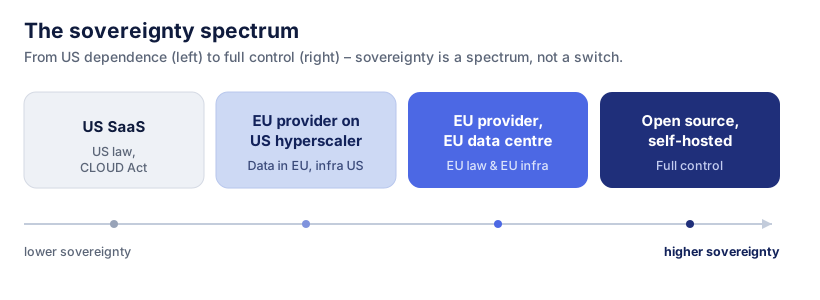
Not every organisation can or must host everything itself. Often, a European managed provider is the pragmatic middle ground between convenience and control.
How to recognise sovereignty
Sovereignty can be increased step by step by paying attention to individual criteria:
- Provider located in the EU, EEA or EFTA
- Ownership structure – is the provider controlled from a non-EU country?
- Data processing within the EU, with a DPA
- Transparent sub-processors
- Open standards and exportable data
- Open source and the option of self-hosting
These criteria feed into our sovereignty score. Why the server location alone is not enough is explored in EU hosting vs. US hosting.
A realistic view
What matters is knowing your own requirements and consciously accepting dependencies – instead of overlooking them. For sensitive data the biggest step pays off; for non-critical tools an EU managed provider is often enough. An overview of concrete alternatives is available in our categories.
Frequently asked questions
Is digital sovereignty the same as data protection?
No, but they are connected. Data protection (GDPR) governs how personal data is handled. Sovereignty is broader: it also covers technological independence and avoiding lock-in. A sovereign setup makes data protection easier but does not replace it.
Do I have to self-host to be sovereign?
No. Self-hosting is the strongest lever, but not the only one. A European provider with EU data processing, clear contracts and open standards offers the pragmatic middle ground for many organisations.
Is an EU data centre enough?
Not necessarily. If the provider is subject to US law through its ownership structure, the EU location alone may not suffice. Headquarters and ownership matter as much as the storage location.
How to put sovereignty into practice is shown in our practical guide Replacing US software: the path to a European software stack.
This article is an editorial assessment and not legal advice.
The Sovereignty Score is an editorial orientation aid, not legal advice. How we rate.