
Last checked: 12. Juli 2026
Replacing US software: the practical guide to a European software stack
An actionable roadmap for switching step by step from US tools to European alternatives – with a priority matrix, selection criteria and concrete recommendations for every software category.
By the Euro Toolhub editorial team · editorially reviewed
Many teams want to become less dependent on US software – for privacy, predictable pricing or digital sovereignty. The leap often looks bigger than it is. This guide shows a realistic, proven path: not "everything at once", but prioritised, category by category and without operational risk. With a decision framework, a priority matrix, selection criteria and concrete European alternatives for every category.
If you want to cover the basics first, read What does digital sovereignty mean?. This guide is the practical follow-up – and editorial guidance, not legal advice.
The essentials in brief
- Sovereignty is a spectrum. An EU provider with an EU data centre is usually enough – self-hosting is not mandatory.
- Prioritise. Start with high privacy risk and low effort (web analytics, newsletters), not the whole stack at once.
- Look at headquarters, ownership and sub-processors – not just the server location.
- For virtually every category there are mature European alternatives (see the quick overview below).
- An EU location alone is not GDPR compliance. Configuration and a DPA are part of it.
Why now is the right time
The question of European software has shifted from a niche topic to a strategic decision. Three developments drive it:
- Legal uncertainty with US services. Since the Court of Justice's Schrems II ruling (2020), and despite the EU-US Data Privacy Framework (2023), transferring data to the US remains a recurring risk. The US CLOUD Act lets US authorities in theory demand access to the data of US providers – even when that data sits in Europe.
- Predictability and geopolitics. Abrupt price jumps, changed licensing models and political tensions make dependence on a few US corporations a business risk.
- Mature European alternatives. For virtually every category there are now European providers that keep up functionally – often with better privacy, EU data residency and support in your language.
Switching is therefore not ideological but pragmatic: reduce risk, gain control, stay predictable.
Sovereignty is a spectrum, not a switch
There is rarely one "sovereign" solution. Between a US service and a self-hosted open-source tool lie several gradations – and most organisations deliberately land in the middle.
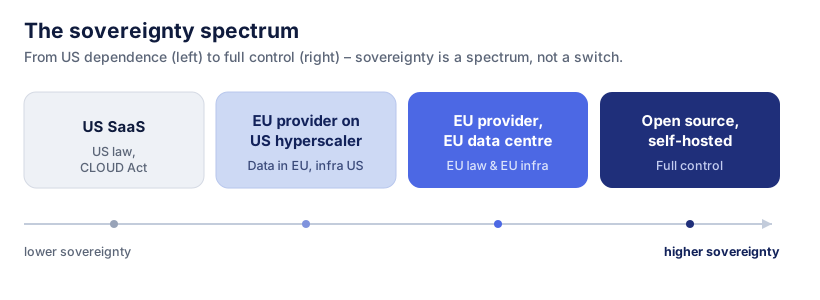
- US SaaS – provider and law in the US. Convenient, but with the risks described.
- EU provider on a US hyperscaler – a European company, but infrastructure from AWS, Azure or Google. Better than a US provider, but not fully independent.
- EU provider with an EU data centre – headquarters and data processing in the EU/EEA, under European law. For most organisations the pragmatic target state.
- Open source, self-hosted – maximum control, but operational and security effort.
The goal is not dogma but a deliberate decision: where does your most sensitive data sit? That is where the biggest step pays off. For non-critical tools, an EU managed provider is often enough. Why the server location matters is explored in EU hosting vs. US hosting.
The legal situation in brief
Three terms come up again and again – here is the short, practical take (not legal advice):
- GDPR – governs the processing of personal data in the EU. Your company always remains responsible, not the provider.
- Schrems II – the CJEU ruling that ties transfers of personal data to the US to strict conditions. It is why pure EU processing reduces risk.
- US CLOUD Act – obliges US providers to hand over data on official order, regardless of storage location. This is why a provider's ownership structure (not just the server location) is decisive.
Remember: a data centre in Frankfurt alone does not make a service "safe" if the parent company is subject to US law. Conversely, an EU provider is not automatically GDPR-compliant – the right configuration and a data processing agreement are part of it.
Spotting EU-washing: real vs. apparent sovereignty
Not everything labelled "European" actually delivers sovereignty. These warning signs help tell real alternatives from apparent ones:
- "EU data centre" but a US parent company. The servers are in the EU, but the provider belongs to a US company – so the CLOUD Act may apply.
- Obscured ownership structure. If it is not clear who owns or controls the provider, be cautious.
- US sub-processors in the background. The front end looks European, but core services (hosting, email sending, analytics, support tools) run via US providers.
- "GDPR-compliant" as a pure marketing label – without a DPA, without a sub-processor list, without a concrete server location.
- Open source as a label only. An "open core" with a proprietary core tied to the cloud brings little real independence.
Remedy: check the headquarters, ownership, sub-processor list and DPA – exactly what our sovereignty score makes transparent for every provider.
Step 1: Take stock of your stack
Before you replace anything, get an overview. List all the tools you use and note for each:
- Which data flows through it (personal? business-critical? public?)
- Who is the provider and where are they based (country, owner)?
- How deeply integrated is the tool (standalone or a linchpin)?
- How many people depend on it?
Our EU Stack Check offers a quick start: select your current tools and get matching European alternatives together with a sovereignty assessment.
Step 2: Prioritise by risk and effort
Not every tool is equally urgent. Sort your candidates into four fields – by privacy risk (how sensitive is the data?) and migration effort (how deeply embedded is the tool?):
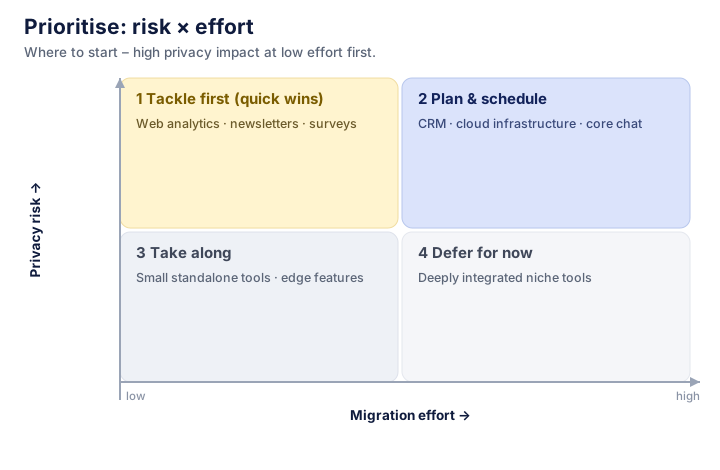
- High risk, low effort – first. Classics: web analytics, newsletters, surveys. Lots of personal data, yet quick to switch.
- High risk, high effort – plan and schedule: CRM, cloud infrastructure, the central communication tool.
- Low risk, low effort – take along on the side.
- Low risk, high effort – defer for now.
This way you achieve visible early wins without overreaching on a big project.
Step 3: The right selection criteria
For every alternative it is worth looking at the same criteria – exactly those that feed into our sovereignty score:
- Provider location in the EU, EEA or EFTA – not just the server location.
- Ownership structure – is the provider controlled from a non-EU country?
- Data processing within the EU, with a data processing agreement (DPA).
- Sub-processors – which service providers are involved, and where are they based?
- Open standards and exportability – can you get out again if needed (lock-in)?
- Open source and self-hosting – optional, but the strongest sovereignty lever.
- Certifications such as ISO/IEC 27001 or (in France) SecNumCloud.
An honest note: an EU location alone does not automatically make a tool privacy-compliant – and open source does not automatically make it secure. It is the combination of criteria that counts. A detailed checklist is provided by our guide Choosing GDPR-compliant software.
Step 4: Replace category by category
The actual replacement works best category by category. For the most common US tools there are established European alternatives. The quick overview shows, per US tool, the top-ranked European recommendation and its sovereignty score; the notes below explain what matters in each case.
Quick overview: US tool → European alternative
| US tool | Top pick (EU) | Sovereignty |
|---|---|---|
| Google Analytics | Matomo | 78 |
| Mailchimp | Brevo | 68 |
| Gmail | Proton Mail | 82 |
| Slack | Wire | 86 |
| Zoom | Jitsi Meet | 60 |
| AWS | STACKIT | 89 |
| Dropbox | Nextcloud | 90 |
| Salesforce | SuperOffice | 80 |
| Asana | awork | 80 |
| Stripe | Mollie | 82 |
| DocuSign | Yousign | 90 |
| 1Password | Proton Pass | 82 |
| ChatGPT | Mistral | 82 |
| Google Search | Qwant | 88 |
Sovereignty score (0–100) of the top-ranked European provider, as of July 2026. Current values, pros/cons and further alternatives are on each linked page.
- Web analytics. The classic quick win: Google Analytics can often be replaced cookie-free and without a consent banner. Google Analytics → Matomo, Plausible & co. · Category: web analytics.
- Newsletters & email marketing. Lots of contact data, quick switch: Mailchimp → European newsletter tools such as Brevo or CleverReach.
- Email inbox. Look for end-to-end options and an EU server location: Gmail → privacy-friendly mail providers · Category: email.
- Team chat & messaging. End-to-end encryption matters here: Slack → alternatives, Microsoft Teams → alternatives, WhatsApp → secure messengers.
- Video conferencing. Zoom → Jitsi, Whereby & co. – partly self-hostable.
- Cloud & hosting. The big one, but the biggest sovereignty effect: AWS → European cloud providers · Category: cloud & hosting.
- Files & collaboration. Dropbox → alternatives, Google Drive → alternatives.
- CRM. Usually deeply integrated – plan well: Salesforce → alternatives, HubSpot → alternatives · Category: CRM.
- Project management. Asana → alternatives, Trello → alternatives, Jira → alternatives.
- Payments. Look for an EU licence (EMI/PSP): Stripe → alternatives, PayPal → alternatives · Category: payments.
- E-signature. For legal validity, look for eIDAS/QES: DocuSign → eIDAS alternatives · Category: e-signature.
- Password managers. Open source and self-hosting are a strong plus here: 1Password → alternatives, LastPass → alternatives.
- AI language models. EU processing for sensitive prompts: ChatGPT → European AI models such as Mistral or Aleph Alpha.
- Search. Google Search → European search engines.
You will find all categories at categories; a full list of the rated providers at providers.
Step 5: Migration without friction
A switch rarely fails because of technology, but because of execution. A five-phase approach works well:
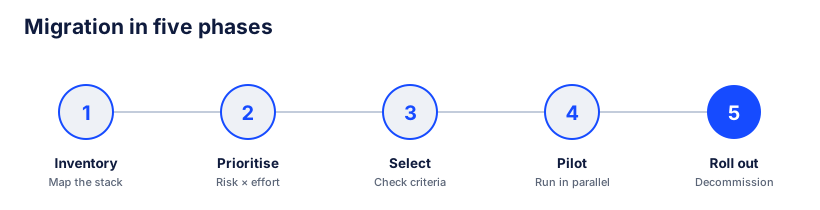
- Run in parallel – keep the new and old tool running together for a while and compare results.
- Export data early – before the move, check whether and how you can get your data out of the old tool.
- One tool at a time – parallel major migrations overwhelm teams.
- Bring people along – a short introduction, clear points of contact, taking feedback seriously. Acceptance matters more than features.
- Pilot first, then roll out – test with a small team, then deploy.
Estimating cost and effort realistically
Sovereignty has a price – but often a lower one than expected. Be honest in your calculation:
- Licence costs of European providers are often comparable or cheaper; prices in euros make budgeting easier.
- Migration effort is a one-off (export, setup, training) and pays off over time.
- Operating costs of self-hosting should not be underestimated: servers, updates, security, backups. Without these resources, an EU managed provider is the smarter choice.
- The opportunity cost of doing nothing: legal risk, lock-in and dependence also have a price.
Special cases: public sector, healthcare, finance
In heavily regulated areas, sovereignty is not optional but mandatory. Public administration, healthcare and the financial sector process especially sensitive data and are subject to additional requirements. Here, EU data residency, demonstrable certifications and – where possible – open source and self-hosting are particularly important. For legally binding signatures, there is hardly a way around an eIDAS-compliant, qualified provider (QES).
Common mistakes
- Wanting everything at once. Prioritising beats perfection.
- Only looking at the server location. Headquarters, ownership and sub-processors matter just as much.
- Confusing sovereignty with compliance. An EU tool is not automatically GDPR-compliant – the right configuration is part of it.
- Forcing self-hosting. Without resources for operations and security, a European managed provider is often the better choice.
- Forgetting the team. The best alternative is useless if no one uses it.
Frequently asked questions
Do I have to migrate my entire stack at once?
No – and that is in fact the most common mistake. Start with one or two tools that carry high privacy risk and low effort (e.g. web analytics or newsletters). Early wins build confidence for the bigger steps.
Is a European alternative always the better choice?
Not across the board. What matters is your requirements: type of data, feature set, budget and operational resources. European providers score on data sovereignty and legal clarity; in individual cases a US tool may (still) be functionally ahead. The point is a conscious trade-off.
Is it enough if the data sits in an EU data centre?
Not necessarily. If the provider is subject to US law through its ownership structure (CLOUD Act), the EU server location alone may not suffice. So look at headquarters and ownership, not just the storage location.
How do I know how sovereign a provider really is?
We rate every provider against fixed criteria (location, data processing, sub-processors, open source, certifications) with a sovereignty score including a confidence level. So you can see at a glance where a provider is strong – and where there are limitations.
How long does a migration take?
It depends on the tool. A web analytics or newsletter switch is often done in days, while a CRM or cloud move can take weeks to months. That is exactly why the prioritisation in step 2 pays off.
Next step
The quickest start is our EU Stack Check: select your current tools, get matching European alternatives. From there you work your way forward category by category.
This article is editorial guidance, not legal advice. In critical cases, a legal review should be carried out.
The Sovereignty Score is an editorial orientation aid, not legal advice. How we rate.